Storyboard AI, Script-to-Visual Generator
Turns scripts into visual storyboards with character consistency across frames, submitted to Adobe Incubator and beta-tested by 5 marketers for real-world campaign ideation.
- OpenAI image gen
- Scene analysis
- Character consistency
- Style presets
- Incubator submission
- Adobe
- marketers beta-tested
- 5
- style presets
- 5
An AI storyboard generator that transforms a script into a sequence of visually consistent frames, extracting scenes, camera framing, and character descriptions, then generating images that hold character likeness across the storyboard. Submitted to Adobe Incubator; 5 marketers beta-tested for real campaign work.
The premise
Marketers and creative directors think in storyboards, but writing one from a script is slow and most teams skip it. The brief was: take the script, return a storyboard a creative director could walk into a pitch with.
What it does
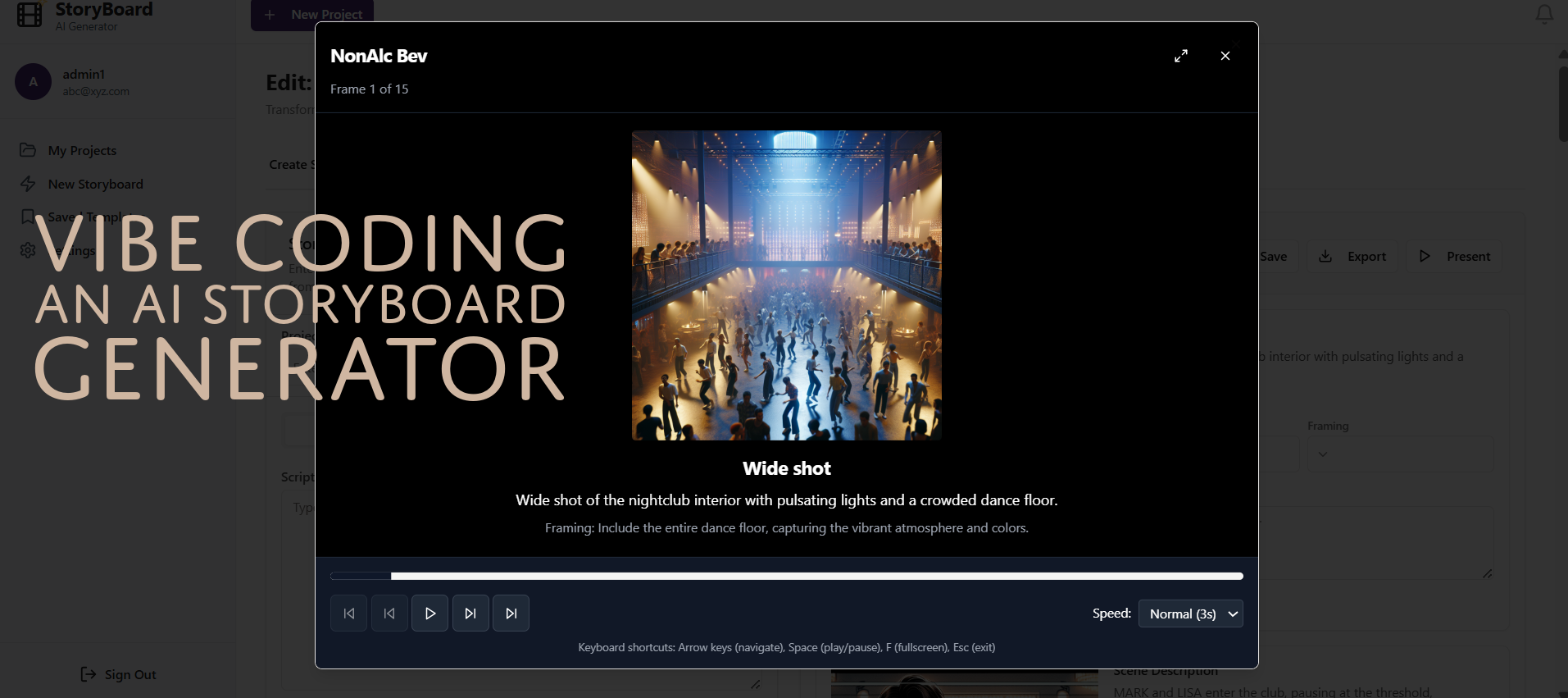
Storyboard AI takes a script, breaks it into logical visual scenes, infers camera framing and angle suggestions per beat, extracts character descriptions for visual consistency, and generates frames in a chosen style, realistic, cinematic, sketch, anime, or noir.
The output is a sequenced board, not a grid of disconnected images. Each frame carries the scene label, the camera note, and the cast it depicts.
Why character consistency is the unlock
Most script-to-image tools fall apart at the second frame, the protagonist looks like a different person every shot. The product call was to invest in character-consistency over breadth of styles. Without it, the output is a mood board, not a storyboard.
The character extraction step runs once per script. Every subsequent frame generation re-injects the same character descriptors, so likeness holds across the sequence.
Who pulled it into real work
Beta-tested by 5 marketers for real-world campaign ideation, moving the tool out of 'cool demo' into the actual pitch-deck workflow. Submitted to Adobe Incubator.
The signal that mattered: marketers came back asking for more styles and longer scripts, not for the tool to be smarter. That is the right complaint to get on a v0.
"The temptation in generative-image products is to chase more styles. The leverage was the opposite, fewer styles, deeper consistency, so the output survives a client meeting. The next bet is character libraries that persist across projects."